
Reviewed · ST ANDREWS & FIFE DAY TRIPS
St Andrews Must-Sees Daily Walking Tour (11am & 2pm)
St Andrews packs golf, saints, scholars, ruined churches, and old town gates into a very walkable center. This 90-minute walking tour gives you the town’s basic story in one sweep, from the Martyrs’ Monument and Old Course to the cathedral ruins and West Port.
I like the small-group feel promised for up to six people, and I like the mix of famous sights and easy-to-miss corners. Guides including Fiona, Ken, Connor, Jamie, and John have been praised for clear storytelling, humor, and useful local detail. The main point to check is group size: the tour description says six, while the booking information allows up to 20 people.
In This Review
- Key points at a glance
- Why this short walk works in St Andrews
- From the Martyrs’ Monument to Scotland’s Reformation
- Golf begins with the New Course
- The Old Course and Royal and Ancient Golf Club
- Castle ruins and the town’s religious battles
- St Andrews Cathedral and the footsteps of martyrs
- University buildings, quads, and student life
- Town Hall and the working side of St Andrews
- Ending at West Port Gate
- Guides make the biggest difference
- Timing, pace, and what to bring
- Who will get the most from this tour?
- Should you book the St Andrews Must-Sees walk?
- FAQ
- How long does the St Andrews walking tour last?
- What time does the tour start?
- Where does the tour begin?
- Where does the tour finish?
- Are admission tickets included?
- Is the tour offered in English?
- How large is the group?
- Can I cancel for a full refund?
Key points at a glance
- Golf and medieval St Andrews in one walk: See the Old Course, Royal and Ancient Golf Club, castle, cathedral, university, and town gates.
- A useful first look: The route helps you decide which sites deserve a paid interior visit later.
- Guides shape the experience: Fiona, Ken, Connor, Jamie, John, and others are noted for warmth, humor, and strong local knowledge.
- Easy pace, real coverage: The walk is casual and manageable, but it covers a fair stretch of central St Andrews.
- Outside views only: Castle, cathedral, golf facilities, and university buildings are seen externally, so admission tickets are not part of the tour.
- Practical finish: You start at the Martyrs’ Monument and end at West Port, not back at the starting point.
Why this short walk works in St Andrews
St Andrews can look simple on a map, yet its landmarks tell very different stories. Golf fans come for the Old Course. History-minded visitors come for the cathedral and castle. Students give the town a young pulse, while the old gates and monuments point to a much earlier Scotland.
The value of this walk is the way it links those parts. You are not just looking at a golf course, then walking to a ruin, then passing a university building without context. A guide explains how religion, education, golf, trade, and town life shaped St Andrews over time.
At $20.80 per person, the tour is priced as an orientation rather than a full attraction package. You are paying for a guide, a clear route, and stories that help you make sense of the town. Since the main stops are exterior visits, you will still need separate admission if you want to enter St Andrews Castle or explore the cathedral grounds beyond what the walk includes.
That arrangement suits me. I would rather understand the town first, then choose where to spend extra time. If you already know St Andrews well, or if your main aim is a long visit inside the castle and cathedral, this walk may feel like a quick preview.
More St Andrews and Fife day trips:
- St Andrews: Golf Origins and Old Course History Tour
★ 4.7 · 322 reviews - St Andrews: Top Sights Guided Walking Tour
★ 4.7 · 223 reviews - St Andrews: Town, Golf, and Old Course History Tour
★ 4.7 · 162 reviews
From the Martyrs’ Monument to Scotland’s Reformation
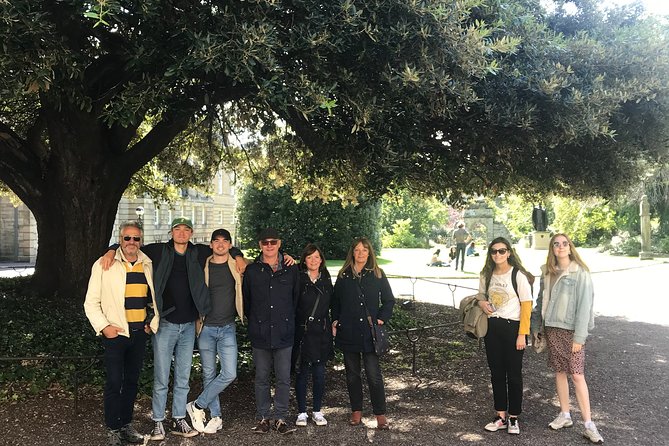
The meeting point is the Martyrs’ Monument on The Scores, a good place to begin because it introduces one of the town’s serious themes: religious conflict and the Scottish Reformation. The guide explains the martyrs remembered around St Andrews and places the town within the wider religious struggles of Scotland.
This opening is brief, listed at about five minutes, but it gives the walk a human story right away. You are not starting with a bland roll call of dates. You begin with people who suffered for their beliefs, then move through a town where religion once shaped daily life and public power.
The Scores also gives you a sense of St Andrews as a place of sea views, old institutions, and historic streets. Keep your ears open here, since the guide’s interpretation matters more than the monument alone.
Golf begins with the New Course
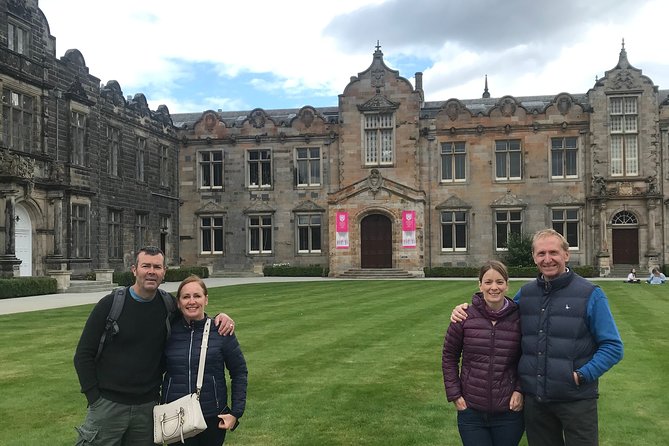
The next stop turns toward St Andrews Links and the New Course. The visit is external and lasts about five minutes, so do not expect a playing experience or a detailed tour of the facilities.
What you get is a short introduction to why St Andrews matters so much to golf. The New Course provides a useful contrast to the Old Course, which receives much of the attention. Your guide connects the links to the town’s international reputation and explains the setting before the route reaches the famous course itself.
This part works best for first-time visitors who want more than a photograph. Golf fans may wish the golf section lasted longer. One review specifically wanted more golf-course history, so if golf is your main reason for coming, consider adding a separate Old Course or golf-focused activity to your day.
The Old Course and Royal and Ancient Golf Club
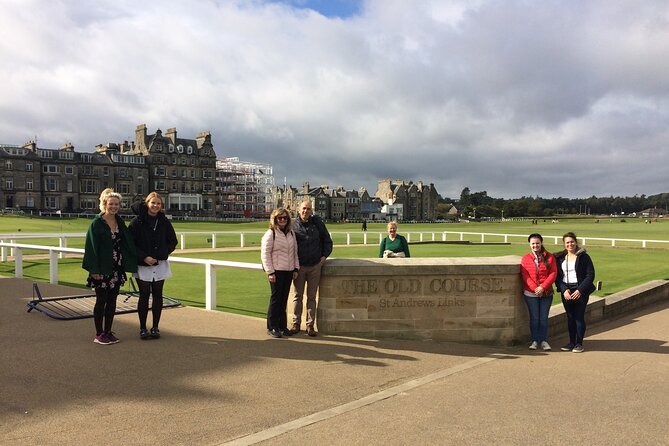
The Old Course is one of the essential St Andrews sights, and the walk gives you an exterior look rather than access to the playing area. The stop lasts about five minutes, but it is enough to place the course within the town instead of treating it as an isolated attraction.
A useful detail is that course access can change during a tournament. If play is taking place, you may be directed to view the course from a platform rather than walk onto areas normally open to the public. That is important for anyone picturing a close-up stroll across the course.
The Royal and Ancient Golf Club follows, with about ten minutes devoted to its exterior. Your guide explains the role of this exclusive club and its place in golf culture. The building itself is part of the experience, but the real benefit is the context. You learn why this corner of St Andrews carries such weight in the golfing world.
I would not book this walk expecting private club access. The description is clear that the visit is outside only. Still, the stop adds useful background and helps non-golfers understand why the town’s golfing identity is more than a famous fairway.
More walking tours in St Andrews:
- Private St. Andrews: Home of Golf Old Course Walking Tour
★ 5.0 · 69 reviews - St Andrews: Guided Walking Tour, 12pm, 2pm daily
★ 5.0 · 28 reviews - St Andrews: Town Highlights Private Guided Walking Tour
★ 4.9 · 25 reviews - St Andrews: 90-Minute Historical Walking Tour
★ 4.8 · 23 reviews
Castle ruins and the town’s religious battles
St Andrews Castle appears next, with roughly five minutes at the exterior. The remains are tied to the religious wars, and the guide explains the castle’s importance rather than simply pointing out broken walls.
The short stop gives you a reason to return for a paid visit if the story catches you. The castle is one of the places where the town’s religious and political tensions become easier to picture. From the outside, you get the broad setting and historical meaning, but not the full experience of exploring the ruins.
If you want to enter, admission is not included. This is one of the tour’s practical strengths and limits: you can see several major places in a single hour and a half, but you should not confuse that with a ticketed sightseeing tour.
St Andrews Cathedral and the footsteps of martyrs
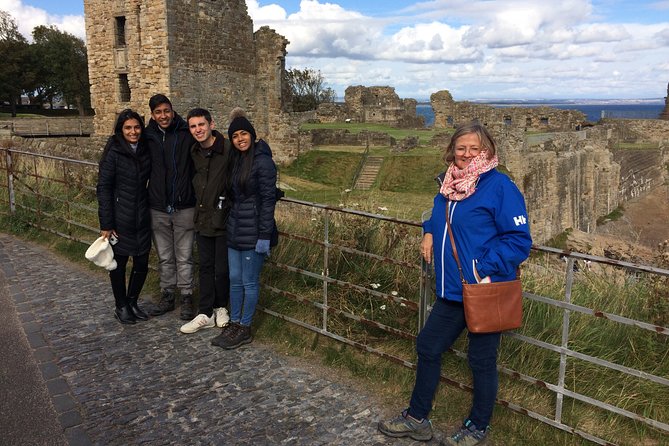
The cathedral stop lasts about ten minutes and focuses on the ruins, the martyrs, and the ministers connected with St Andrews. Of all the historical stops, this is likely to feel most atmospheric, even though the walk remains an exterior visit.
The cathedral was central to the town’s religious importance, and its remains make the scale of medieval St Andrews easier to grasp. Your guide helps tie the stones to the people and conflicts introduced at the Martyrs’ Monument.
This is also a good spot for photographs, but the pace may not allow a long, quiet exploration. If you are drawn to ruined churches and want time to look closely, plan to return after the tour. The walk gives you a framework, then leaves you free to explore further on your own.
University buildings, quads, and student life
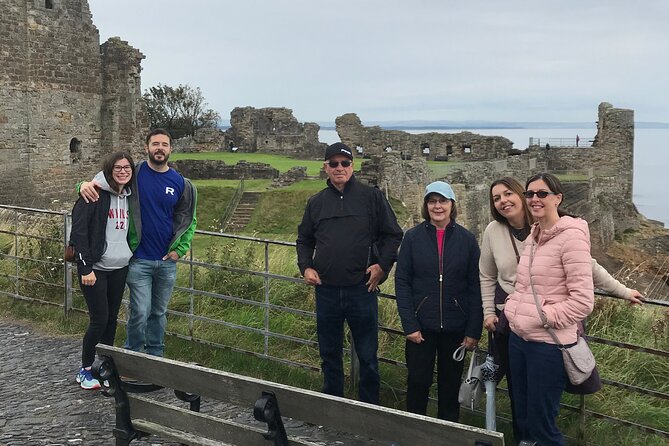
The University of St Andrews receives about ten minutes. Founded in 1413, it is the oldest university in Scotland, and its buildings and quads give the town a different character from the golf links and medieval ruins.
Several guides, including Connor, Jamie, Jenny, Fiona, and John, have drawn particular praise for explaining university life. Student guides can add a present-day view that a purely historical tour might miss. That makes this part especially useful if you are visiting a student, comparing universities, or simply curious about how an old institution functions in a living town.
The balance here may not suit everyone. One piece of feedback suggested spending less time on the university and more on the town’s older history, including the gates and the statue. Your own interests matter. Families considering the university may welcome the extra attention, while visitors focused on medieval St Andrews may want more time at the cathedral and castle.
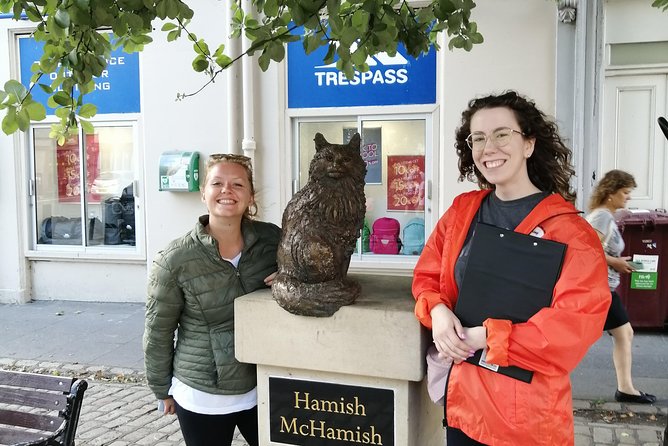
You may also encounter the famous cat statue during this stretch. It is a small stop, but it adds a bit of local personality to a route otherwise filled with serious monuments, institutions, and golf history.
Town Hall and the working side of St Andrews
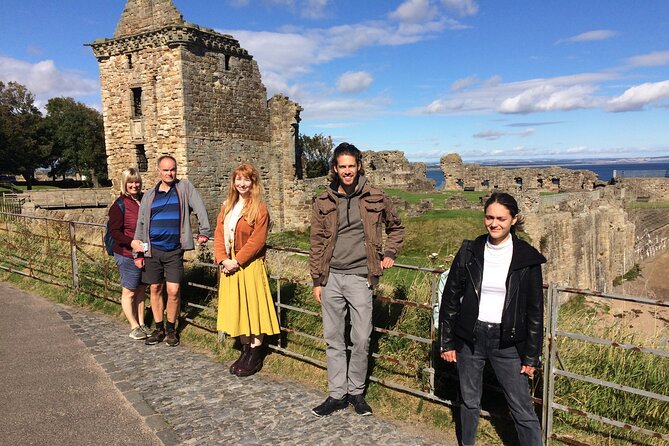
The route then reaches St Andrews Town Hall for about ten minutes. Here, the guide turns toward the industries that supported the town through the ages.
This stop helps widen the picture. St Andrews is not only a place of saints, students, and golfers. Its town life also depended on work, trade, and local industries. A walking tour can make those connections easier to see because you move through the streets where civic life developed.
The visit is external, and no admission is included. The importance of this stop comes from the explanation rather than an interior display. Guides such as Ken and Fiona are especially well suited to this kind of storytelling, where a building opens a door to everyday life rather than a single dramatic event.
Ending at West Port Gate
The walk ends at West Port, an old gate through which millions of people have entered the ancient town. The stop lasts about ten minutes and gives the route a fitting finish.
The ending is worth noting for planning. You do not return to the Martyrs’ Monument. You finish near the gate on the A918, close to the town center, so you can continue sightseeing, find lunch, visit a paid attraction, or make your own way onward.
One practical drawback is that the finish can feel slightly confusing if you expect to be led back to the start. I recommend opening a map before the tour and noting both points. The route is not difficult, but knowing where you will finish removes a small bit of post-tour fuss.
Guides make the biggest difference
The strongest part of this experience is the guide. The names that come up repeatedly include Fiona, Ken, Connor, Jamie, John, Jenny, and Colin. Their styles differ, but the qualities to look for are clear: good pacing, clear speech, local stories, and the ability to answer questions.
Ken is described as especially strong at connecting medieval history with present-day St Andrews. Fiona is praised for warmth, humor, enthusiasm, and a broad command of the town. Connor brings a student’s perspective and an upbeat manner, while Jamie is noted for making information easy to follow.
That range matters because the walk covers several subjects quickly. A dry guide could make the route feel like a list of buildings. A lively guide can connect golf, university life, religious conflict, and local tradition in a way that stays with you.
The group-size information deserves a careful look. The experience is presented as a maximum of six for a personal walk, but the additional booking details allow up to 20 participants. If you care strongly about a tiny group, confirm the expected size before booking. A larger group may make it harder to hear, especially outdoors, though the route remains the same.
Timing, pace, and what to bring
The tour runs at 11 a.m. and 2 p.m. and lasts about an hour and a half. The 11 a.m. option leaves plenty of time for a later castle or cathedral visit, while the 2 p.m. departure can fit well after lunch or a morning arrival.
The walk is described as easy and casual. Most people should be able to take part, and service animals are allowed. Still, you are walking between several parts of central St Andrews, so sensible shoes and a weather-ready jacket are wise in Scotland.
Because the experience requires good weather, poor conditions can lead to a new date or a full refund. The tour also requires a minimum number of participants, so a cancellation is possible if that minimum is not reached. Free cancellation is available up to 24 hours before the start time, but changes or cancellations inside that window are not accepted.
The tour is offered in English and uses a mobile ticket. It is near public transportation, which helps if you are arriving for a day visit. Confirmation is sent at booking, so keep the ticket easy to reach on your phone.
Who will get the most from this tour?
I would choose this walk for a first visit to St Andrews, especially if you have only part of a day. It gives you a sensible map in your head and explains why the main sights matter before you spend time inside them.
It also suits:
- Golf fans who want the town’s course and club explained, not just photographed.
- University families who want a quick look at the buildings and student setting.
- History lovers who want the Reformation, castle, cathedral, and town gates connected.
- Day visitors from Edinburgh who need an efficient introduction.
- Curious walkers who prefer local stories to a self-guided list of stops.
I would think twice if you want long interior visits, an intimate golf-course experience, or a tour devoted mainly to one subject. This is an overview. Its strength is variety, not depth at any single site.
Should you book the St Andrews Must-Sees walk?
Book it if you want a friendly, efficient introduction to St Andrews before exploring on your own. The $20.80 price is fair for a guided route that covers golf, religion, university life, civic history, and the town’s old entrances in about 90 minutes.
The best plan is to use the walk as your foundation. Pay attention to the sites you want to revisit, then return to the castle, cathedral, or university area at your own pace. If the Old Course is your priority, check tournament conditions and remember that this tour provides an outside view only.
Confirm the group size if the promised small-group setting is important to you. Otherwise, choose the time that fits your day and book with the expectation of a lively overview, strong guide-led storytelling, and a finish at West Port rather than back at the monument.
FAQ
How long does the St Andrews walking tour last?
The tour lasts approximately 1 hour and 30 minutes.
What time does the tour start?
It is offered daily at 11 a.m. and 2 p.m.
Where does the tour begin?
The meeting point is the Martyrs’ Monument on The Scores, St Andrews, KY16 9AT.
Where does the tour finish?
The tour ends at West Port Gate on the A918, St Andrews, KY16 9FB. It does not return to the starting point.
Are admission tickets included?
No. The castle, cathedral, golf facilities, and university stops are exterior visits, and admission tickets are not included. The Martyrs’ Monument and West Port Gate are free to view.
Is the tour offered in English?
Yes. English is the stated tour language.
How large is the group?
The experience is described as a small-group tour with a maximum of six, but the additional booking information states that the activity can have up to 20 participants. Confirm the expected group size if this matters to you.
Can I cancel for a full refund?
Yes, if you cancel at least 24 hours before the experience start time. Cancellations or changes made less than 24 hours before the start time are not accepted for a refund. If bad weather or an insufficient minimum number of participants cancels the tour, you can receive a different date or a full refund.
Just added around St Andrews
- Barrel-top whisky tasting in St Andrews★ 5.0 · 20 reviews
- St Andrews: 90-Minute Historical Walking Tour★ 4.8 · 23 reviews
- St Andrews: Town Highlights Private Guided Walking Tour★ 4.9 · 25 reviews
- St Andrews: Guided Walking Tour, 12pm, 2pm daily★ 5.0 · 28 reviews
- Bespoke Private Tours of Scotland and the Borders★ 5.0 · 29 reviews
- Private St. Andrews Tour with Dedicated Local Guide★ 5.0 · 38 reviews
- Watch Building Experience – St Andrews★ 5.0 · 40 reviews
- St Andrews History Tours★ 5.0 · 41 reviews
St Andrews & Fife Day Trips, compared.

St Andrews & the Fishing Villages of Fife Small-Group Day Tour from Edinburgh
Read our review →

Rosslyn Chapel, Dunfermline Abbey and Stirling Castle Day Tour
Read our review →
Rosslyn Chapel, Stirling Castle & Dunfermline Abbey Tour
Read our review →
Browse the lists this tour appears in